Baseball Daily Miscellany

Diminutive snippets and quirks from baseball history

Category: Uncategorized

1968

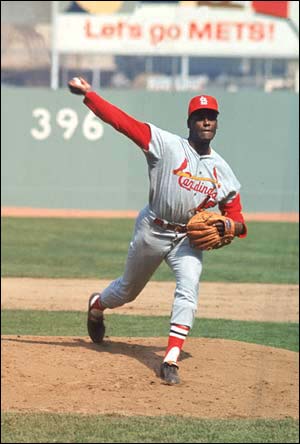
In 1968, the pendulum had swung hugely to favour the pitcher over major league batsmen. In that year, Carl Yastzremski won the American League batting title with an all-time low batting average of just .301. In addition, Denny McLain of the Detroit Tigers won 31 games, making him the last player to win 30 games in a season, and St Louis starting pitcher Bob Gibson completed the season with an astronomically low ERA of just 1.12. As a result, from 1969 the pitching mound was lowered and the strike zone reduced.

Bob Gibson

Team Nicknames

 American League

Team Nicknames
Baltimore Orioles O’s
Birds
Boston Red Sox BoSox
The Sox
Chicago White Sox ChiSox
Southsiders
Cleveland Indians The Tribe
The Redskins
Detroit Tigers The Motor City Kitties
The Pinetars
Kansas City Royals R’s
Los Angeles Angels Halo’s
Seraphs
Minnesota Twins Twinkies
New York Yankees The Bronx Bombers
The Pinstripes
Oakland Athletics A’s
Seattle Mariners M’s
Tampa Bay Rays Rays
Texas Rangers Strangers
Toronto Blue Jays Jays

National League

Team Nicknames
Arizona Diamondbacks D-Backs
Snakes
Atlanta Braves Bravos
America’s Team
Chicago Cubs Cubbies
Northsiders
Cincinnati Reds Redlegs
The Big Red Machine
Colorado Rockies Rox
Miami Marlins The Fightin’ Fish
Miracle Marlins
Houston Astros ‘Stros
Lastros
Los Angeles Dodgers Bums
Blue Crew
New York Mets The Kings of Queens
The Amazin’ Mets
Milwaukee Brewers Brew Crew
Beermakers
Philadelphia Phillies Phils
Pittsburgh Pirates Bucs
St Louis Cardinals Cards
Redbirds
San Diego Padres Pods
Friars
San Francisco Giants G-Men
Jints
Washington Nationals Nats

The Great Moments (1)

The Shot Heard Around The World

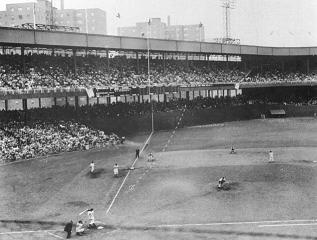
In 1951, both the Brooklyn Dodgers and New York Giants finished the regular season with identical 96-58 records in the race for the National League pennant which meant a three-game playoff. That the play-off had been forced at all was a minor miracle as the Giants, under tough talking former Dodgers manager Leo “The Lip” Durocher won 37 of their final 44 games to claw back a deficit that had been a massive 13 ½ games in mid-August.

Brooklyn won the toss for home advantage and opted to play the Game 1 at Ebbets Field which meant the remaining two games would be fought out at the Giant’s Polo Grounds in Upper Manhattan. The Dodgers’ plan backfired as the Giants took the first game 3-1 with a two run home run by Glasgow born Bobby Thompson off Brooklyn starting pitcher Ralph Branca. But the Dodgers avenged this defeat when the tie moved north to the Polo Grounds with a 10-0 complete game shutout by former World War II paratrooper Clem Labine, thus setting up the decisive game at the Polo Grounds on 3 October 1951.

 The decider was touted as a pitching battle between the Dodgers 20 game winner Don Newcombe and Sal Maglie who had won 23 games for the Giants. It was a tight contest, with the Dodgers taking the lead in the first inning and the Giants unable to draw level until the bottom of the seventh inning. The game then exploded into life. In the eighth, Maglie conceded 3 runs and the Dodgers moved into the bottom of the ninth inning with what looked like an unassailable 4-1 lead. Newcombe, like his opposite number Maglie was feeling the affects of a long, hard season and attempted to retire from the game only to be persuaded to stay on the mound by the influential Jackie Robinson. However, his tired arm then proceeded to give up two singles and a double, allowing the Giants to score, making it 4-2. With Mueller and Lockman of the Giants on base, Dodgers manager Charlie Dressen decided to relieve Newcombe with Ralph Branca. It was a puzzling move as Bobby Thomson was next up to bat for the Giants and had scored several home runs off Branca that year, including the winning home run in Game 1, just two days earlier. What followed is possibly the most famous play in baseball’s illustrious history. Branca’s first pitch was a fastball and a strike for 0-1. His second was also a tactical fastball straight at Thomson’s body, but the batsman shifted back and pulled a line drive into the left field stands. With two players on base, the three run home run had won the game for the Giants and was described famously and ecstatically by the normally calm and collected Giant’s radio commentator Russ Hodges:

 Branca throws…there’s a long drive, it’s gonna be, I believe…THE GIANTS WIN THE PENNANT!! THE GIANTS WIN THE PENNANT! THE GIANTS WIN THE PENNANT! THE GIANTS WIN THE PENNANT! Bobby Thomson hits into the lower deck of the left-field stands! The Giants win the pennant and they’re going crazy, they’re going crazy! Ohhhhh-oh!!!”

 The most famous home-run in history was immortalised as the “Shot Heard around the World” after an article in the New York Daily News described it as such in a report on the game the following day. Unfortunately for the Giants, the momentum didn’t carry and they lost the World Series to Joe DiMaggio and the New York Yankees in six games. 
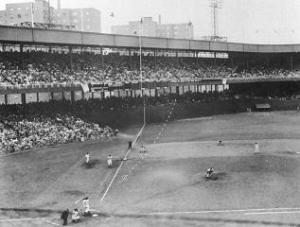
Thomson's famous line drive
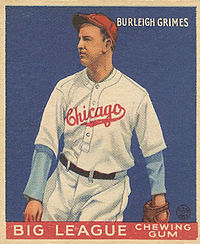
Ol’ Stubblebeard

Burleigh Grimes began his major league baseball career in September 1916 as a pitcher. He never shaved on the days he pitched which led to his nickname, Ol’ Stubblebeard.

He was renowned for throwing the spitball, a ball whose trajectory was averted most commonly by the application of saliva. Such ball tampering was outlawed in 1920 but Grimes was one of 17 spitballers who were permitted at the time to continue using such tactics until their retirement. Grimes was the last surviving member of this unique club, retiring in 1934, his spitters having helped him appear in four World Series.

No Average Joe

In 1911 and 1912, “Shoeless” Joe Jackson of the Cleveland Naps achieved batting averages of .408 and .395 respectively. Incredibly, neither average was enough to gain him the American League batting title as he was beaten in both years by the great Ty Cobb of the Detroit Tigers who posted stats of .420 and .410.

Jackson was banned from the game in 1920 after his association with the “Black Sox Scandal” in which team members of the Chicago White Sox participated in a conspiracy to fix the 1919 World Series.

Brave New Worlds

The Braves franchise has played in Atlanta, Georgia since 1966. They have played in two other cities under five different franchise names: 

Boston Red Stockings 1871-1882
Boston Beaneaters 1883-1906
Boston Doves 1907- 1910
Boston Rustlers 1911
Boston Braves 1912-1935
Boston Bees    1936-1940
Boston Braves 1941-1952
Milwaukee Braves 1953-1965
Atlanta Braves            1966-present

The Braves won 14 consecutive National League Division Titles between 1991 and 2005. The total included 11 Eastern Division Titles from 1995 to 2005, preceded by 3 Western Division Titles from 1991 to 1993 prior to the 1994 players strike. Despite this, the Braves won only a single the World Series Championship during this period, beating the Cleveland Indians over 6 games (4-2) in 1995.

They also won the World Series as the Boston Braves in 1914 and the Milwaukee Braves in 1957 (becoming the first team to win the Series after relocating). Their 1995 win saw them become the only franchise to have won the World Series in three different home cities.  

Strike One

The first major league players strike was in April 1972 and lasted just 13 days. The strike ended when the owners agreed on a $500,000 increase in pension payments but it meant a total of 86 games were missed – none these were ever played as the owners refused to pay the players whilst they were on strike. As a result some teams only played 153 games, 9 fewer than usual.

It is argued by some Red Sox fans that they lost the 1972 American League East Division to the Detroit Tigers because they were “cheated” by the strike. During the strike period, the Red Sox had 2 games cancelled against the Indians and the Tigers missed 3 games against the Yankees. This meant that the Tigers eventually played one more game than the Red Sox and won the division by half a game, with a record of 86-70, compared to Boston’s 85-70.

The Great Players (1)

Johnny Bench

Johnny Lee Bench was born in Oklahoma City on 7 December 1947. After his father had identified that his son’s best route to achieving their ambition of him becoming a major-league ballplayer was as a catcher, he was selected by the Cincinnati Reds in the 1965 amateur draft and made his major-league debut on 28 August 1967 against the Philadelphia Phillies. The following season, Bench succeeded Tom Seaver as the 1968 National Rookie of the Year, having completed the season with a .275 batting average, 15 home runs and 82 Runs Batted In. But it was as a catcher that Bench truly excelled. He is considered to be one of the best catchers the game has seen and was the pioneer of one-handed catching now prevalent in the modern game. Not one to mix his words, he once boasted “I can throw out any runner alive”. His career total of 10 Gold Gloves (won consecutively from 1968-77) certainly goes some way to evidencing such modesty. In 1997, he was voted by onto the Major League Baseball All-Time Team as Catcher over and above illustrious names such as Yogi Berra, Roy Campanella and Carlton Fisk. He was selected for the All-Century Team in 1999 and played in 14 All-Star games.

His best season statistically was 1970 when he won his first National League MVP (his second followed in 1972), leading the league with 45 home runs. He was also a key member of the Red’s 1975 & 1976 World Series Championship teams, which were fondly nicknamed “The Big Red Machine”, boasting a powerhouse line-up including Pete Rose, Tony Perez and Joe Morgan as well as Bench himself. Catchers are notoriously subject to enormous physical strain with knee injuries being particularly prevalent due to the awkward crouching position they assume behind the plate. Thus, in 1978 Bench began to play more and more regularly at first or third base to ease his knee problems. He retired in 1983, becoming a broadcaster and after-dinner speaker. He was inducted into the Baseball Hall of Fame in 1989 in his first year of eligibility, fulfilling the prediction of Ted Williams who had signed an autograph for Bench in 1969 which read “To Johnny Bench, a sure Hall of Famer”.

Most All-Star Games

Hank Aaron, Willie Mays, Stan Musial

Brothers in Arms

The Niekro brothers, Phil and Joe have the most combined wins for brothers pitching in the Major Leagues with 539. They are closely followed by the Perry brothers, Gaylord and Jim with 529 wins between them.

These siblings are also the only pitching brothers to achieve the accolade of each brother having won 20 games in the same season; the Perry’s having accomplished the feat in 1970 which was matched by the Niekro’s in 1979. Gaylord Perry and Phil Niekro were both later inducted into the Hall of Fame.